Window Replacement in Philadelphia: Cost, Rowhouse Rules & Permits (2026)
Advertising disclosure: United Renewals is free to use. We may be compensated when you request quotes through our partners, which can affect which offers appear. See “How We Make Money” in our footer for full details.
Get free quotes from vetted Philadelphia window installers
Get free quotesWhy windows in Philadelphia are different
Philadelphia is a rowhouse city — roughly 70% of its housing stock is rowhomes — and one of the oldest big-city housing stocks in America: 40% of units were built before 1940, and 55% before 1950. That combination shapes every bid. Brick openings and original sash-weight frames push crews toward full-frame replacement more often than the quick insert jobs common in newer suburbs, and any pre-1978 home (most of the city) triggers EPA lead-safe (RRP) work practices.
The flip side is homeowner-friendly: unlike cities such as Chicago that permit every swap, Philadelphia exempts like-for-like window replacement on one- and two-family homes from permits entirely — unless the property is historic. Fewer exposed walls also means fewer windows per home, so a whole-rowhome job is often smaller and cheaper than a detached-house job in the suburbs.
Permits and licensing: easier than you think, with two traps
The City's own EZ-permit guidance says it plainly: exterior window and door replacement with no change in size needs no permit on one- or two-family dwellings — *unless they are historic*. Change the opening size or location and you're into a standard L&I alteration permit; larger multifamily buildings use the no-plans EZ permit route. The first trap is the Philadelphia Register of Historic Places: listed properties (including whole historic districts) need Philadelphia Historical Commission approval before any window replacement, and the Commission expects replacements to match the originals in proportion, form, and materials — staff review typically takes a couple of weeks, full-commission cases considerably longer. Check your address before you sign anything.
The second trap is licensing. Pennsylvania has no state contractor *license* — instead, HICPA requires home-improvement contractors to register with the PA Attorney General, and the registration number must appear in the contract and their ads (verify it free at hicsearch.attorneygeneral.gov). Philadelphia adds its own layer: home-improvement-only contractors on one- and two-family homes don't need the full city Contractor License, but to pull any city permit they must have their PA HIC registration on file with L&I, $500k liability insurance, and clean city taxes. See how to choose a window installer for the full vetting checklist.
Glass for a 4A climate: both seasons count
Philadelphia sits in climate zone 4A — mixed-humid — which puts it in ENERGY STAR's North-Central zone. The v7.0 spec to ask for is U-factor ≤ 0.25 and SHGC ≤ 0.40: low enough U to hold furnace heat through a February cold snap, capped SHGC so July sun doesn't cook the third floor. That balance is the point — a Sun Belt window wastes free winter sun, a far-Northern spec runs hot in summer. Double-pane with argon and low-e hits the number for most homes; triple-pane earns its premium mainly on drafty exposures and street-noise blocks.
Rowhouse realities: brick openings, sash weights, and lead paint
A Philly rowhome concentrates the whole window job on two facades — party walls have no openings — so you're often replacing 8–12 windows, not 25. But those openings are the hard kind: brick masonry with original sash-weight frames that are frequently out of square or rotted at the sill. When the frame is sound, an insert replacement preserves the look and costs less; when it isn't, budget for full-frame, which opens the wall to insulate the old weight pockets — a meaningful efficiency win in pre-war stock. Every bid should state which install type it prices, or you're comparing apples to bricks.
And because most of the city predates 1978, expect lead-safe RRP containment on the job — plastic sheeting, HEPA cleanup, certified crew. It adds prep time per opening; a bid that ignores it on a pre-war rowhome is a compliance problem, not a bargain.
Help paying for Philadelphia windows
- PECO: 2026 residential rebates cover heat pumps, heat-pump water heaters, and select appliances — there's currently no direct PECO window rebate, so don't let a pitch imply otherwise.
- PECO LIURP (income-eligible): free energy audits and weatherization measures — insulation, caulking, weather-stripping — for households at or below 200% of the federal poverty level with high usage. It doesn't fund full window replacement.
- PA Whole-Home Repairs — don't count on it: the original funding is spent and the program received no new money in the 2025–26 state budget; most county waitlists are closed.
- Federal 25C credit — ended: the energy-efficiency window tax credit terminated for installs after December 31, 2025. A 2026 install doesn't qualify, whatever last year's flyer says.
Pro tip from our network contractors
In Philadelphia, run three checks before you sign: look up the contractor's HICPA number at hicsearch.attorneygeneral.gov (it must be in the contract), look up your address on the Philadelphia Register of Historic Places (Historical Commission approval comes before the contract, not after), and make the bid state insert vs. full-frame for a pre-war brick opening. Good Philly installers clear all three without blinking.
How much do windows cost in Philadelphia?
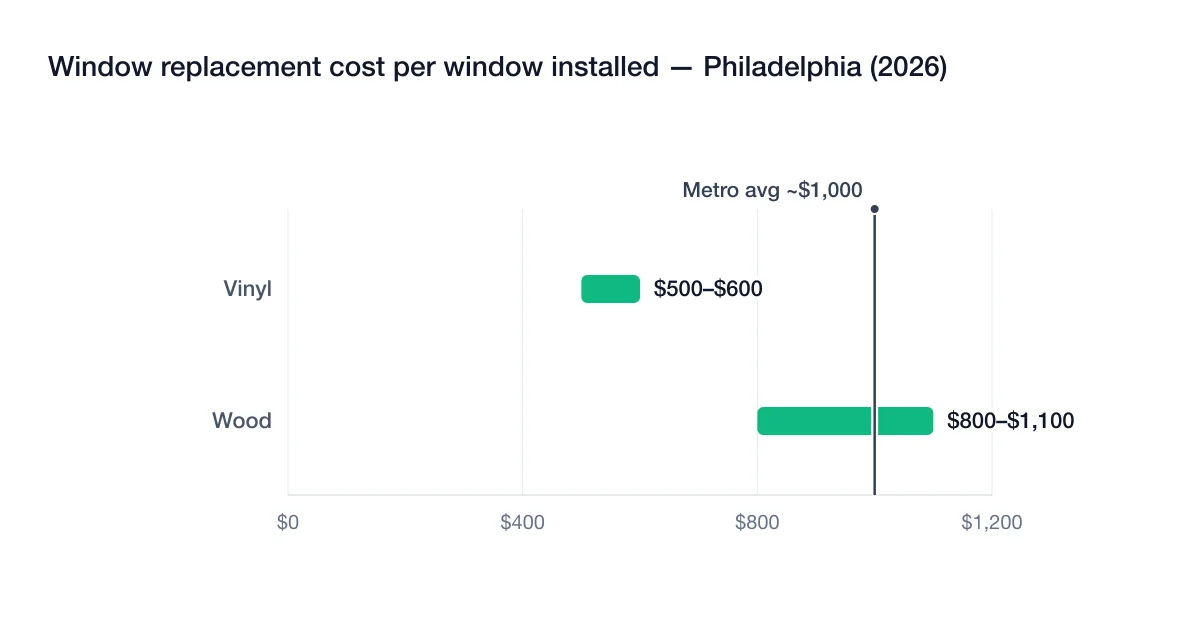
Expect roughly $500–$1,100 per standard window installed — vinyl double-hungs at $500–$600, wood double-hungs at $800–$1,100, with the metro average landing near $1,000 because so many Philly jobs involve full-frame work in brick and lead-safe prep. A typical 10-window rowhome runs about $4,700–$5,900 in vinyl or $7,100–$10,600 in wood. Historic-district jobs price higher still: the Commission's match-the-original standard usually means wood or wood-clad units with simulated divided lights. See the full window replacement cost guide for the national breakdown, and the Pennsylvania windows page for statewide context.
Compare free quotes from local Philadelphia window installers
Get free quotesWhat drives windows cost in Philadelphia, PA
National averages hide a lot. These are the local figures that move a Philadelphia, PA quote away from the national number.
- Licensing in Pennsylvania
PA Attorney General (HICPA registration) + Philadelphia L&I: Pennsylvania requires home-improvement contractors doing $5,000+ of work a year to register with the Attorney General under HICPA — the registration number must appear in the contract and ads (verify it at hicsearch.attorneygeneral.gov). Philadelphia adds a city layer: home-improvement-only work on one- or two-family homes doesn't need the full Philadelphia Contractor License, but to pull city permits the contractor must file their PA HIC registration with L&I, carry $500k general liability insurance, and be current on city taxes.
Source: PA Office of Attorney General (HICPA); City of Philadelphia L&I contractor requirements
- Climate & code factors
- Climate zone 4A (mixed-humid): Philadelphia falls in ENERGY STAR's North-Central zone, where v7.0 calls for U-factor ≤ 0.25 AND SHGC ≤ 0.40 — both winter heat retention and summer heat rejection matter here
- Muggy 90°F summers plus sub-freezing winters mean single-spec shopping fails: a Sun Belt low-SHGC window wastes winter sun, a pure Northern spec overheats in July — the balanced North-Central label is the target
- 40% of Philadelphia's housing units predate 1940 (55% predate 1950) — original single-pane sash in brick openings is among the draftiest stock in any U.S. metro, so the efficiency delta from modern glass is unusually large
- Rowhome party walls leave only front and back facades exposed — fewer windows per home, which concentrates comfort problems (and payback) in a handful of openings
- Rebates & incentives
PECO residential rebates (no direct window rebate) — PECO's 2026 rebates cover ENERGY STAR heat pumps, heat-pump water heaters, and select appliances — there is currently no direct PECO rebate for replacement windows, so treat any pitch that implies one as a red flag
Source: peco.com rebates & discounts listings, checked 2026
PECO LIURP free weatherization (income-eligible) — Free energy audits and weatherization measures (insulation, caulking, weather-stripping — not full window replacement) for households at or below 200% of the federal poverty level with high usage
Source: PECO Low-Income Usage Reduction Program; LIHEAP Clearinghouse PECO profile, checked 2026
PA Whole-Home Repairs Program — effectively closed — The original ARPA funding is spent and the program got no new money in the 2025–26 state budget (its third year without funding); most county waitlists are closed, so don't budget around it
Source: PA DCED; Pennsylvania Capital-Star / Spotlight PA budget coverage, 2025–26
Frequently asked questions
How much does window replacement cost in Philadelphia?
Roughly $500–$1,100 per standard window installed — vinyl double-hungs at $500–$600, wood at $800–$1,100, with the metro average near $1,000. A typical 10-window rowhome runs about $4,700–$10,600 depending on material. Full-frame installs in brick openings and lead-safe prep are what push Philly bids up.
Do I need a permit to replace windows in Philadelphia?
Usually not — Philadelphia exempts like-for-like window replacement (same size, same location) on one- and two-family homes from permits. You do need a permit if you change the opening size, if the building is larger multifamily (EZ permit route), or if the property is on the Philadelphia Register of Historic Places.
What if my Philly home is in a historic district?
Properties on the Philadelphia Register of Historic Places — including whole districts — need Philadelphia Historical Commission approval before window replacement. The Commission expects replacements to match the originals in proportion, form, and materials, which usually means wood or wood-clad units. Staff review takes a couple of weeks; get approval before signing a contract.
What windows are best for Philadelphia's climate?
Philadelphia is climate zone 4A, so ask for ENERGY STAR North-Central spec: U-factor ≤ 0.25 and SHGC ≤ 0.40. Both numbers matter — low U holds heat through winter, the SHGC cap keeps July sun from cooking upper floors. Double-pane low-e with argon hits it for most homes; triple-pane pays on drafty exposures and loud streets.
Are there window rebates in Philadelphia in 2026?
No direct PECO window rebate — their 2026 programs cover heat pumps and appliances. Income-eligible households can get free weatherization (not full window replacement) through PECO's LIURP. PA's Whole-Home Repairs program is out of money, and the federal 25C tax credit ended for installs after December 31, 2025.
Keep reading
Other home projects in Pennsylvania
Windows costs in other markets
Get windows quotes in Philadelphia
Get matched with vetted, licensed local pros and compare free, no-obligation quotes.
100% free · No obligation · Licensed & vetted pros
Other projects worth pricing
Most homeowners bundle exterior work while the crew and access equipment are already on site — it usually costs less than booking each job separately. Quotes are free and carry no obligation.